

- Choose a virtual violin teacher who offers clear demonstrations and a structured progression that steadily builds technique and control.
- Look for strong communication that provides precise corrections, practical practice strategies, and confidence in every lesson.
- Prioritize a teacher who focuses on long-term musical development, independence, and disciplined growth rather than quick results.
Online violin lessons are no longer an experiment. They are a real and powerful way to learn. But let’s be honest. When you remove the shared studio space, the teacher’s skill becomes even more visible. There is nowhere to hide behind proximity or routine. A great virtual violin teacher brings clarity, structure, and musical depth into every session. Others simply fill time. Not all online violin lessons are created equal. The difference is not the platform. It is the person guiding you.
So, if you are looking for the right teacher, what should you actually be paying attention to? Here is what truly matters.
1. Musical Depth and Technical Precision
Online learning removes the shared room. It does not remove the need for excellence. In fact, it raises the bar. A strong virtual violin teacher must have clarity in sound, clarity in explanation, and clarity in demonstration.
a. A Teacher Who Demonstrates
In a virtual setting, tone and posture must be visible and audible through a screen. That means your teacher needs to demonstrate frequently. They should show bow distribution, hand frame, shifting mechanics, and vibrato motion in real time, from multiple angles if needed.
You want someone whose own playing models the standard you are working toward. When a teacher demonstrates phrasing, dynamics, and articulation clearly, students absorb more than instructions. They absorb musical thinking.
This is especially important for beginners and intermediate students, where foundational habits are formed.
b. Clear, Structured Technical Progression
A virtual violin teacher should not simply move from piece to piece. There should be a logical technical arc behind the scenes.
Are scales chosen with purpose? Are etudes assigned to address specific bow strokes or left-hand patterns? Does repertoire match the student’s current skill level without rushing ahead?
The strongest teachers know how to move at the student’s pace, not in a way that lowers standards, but in a way that builds skill step by step. Students should feel stretched but not overwhelmed. Each lesson should connect to the previous one, creating momentum.
c. Attention to Posture and Setup Through the Screen
One common concern about virtual violin instruction is posture correction. A capable online teacher knows how to work around this.
They will ask students to adjust camera angles. They may request side views, full-body shots, or close-ups of the left hand. They will guide students in refining chin rest placement, shoulder rest height, and bow hold alignment with specificity.
This is where preparation also matters. Teachers who discuss your home setup for online classes show that they take online instruction seriously. Lighting, camera height, and audio clarity are not small details. They are tools for better teaching.
d. High Standards for Sound Quality
In a physical studio, sound fills the room naturally. Online, tone must travel through microphones and speakers. That does not mean standards drop.
A strong virtual violin teacher listens carefully for tone production, bow speed, contact point, and left-hand clarity even through digital sound. They may recommend simple microphone upgrades or positioning changes if needed.
But more importantly, they know how to train the ear. They ask students to describe their own sound. They encourage critical listening. They may have students record themselves and review playback together.
This builds independence. The goal is not to rely on the teacher’s ear forever. It is to develop your own.
e. A Balance of Technique and Musicianship
Technique without musical expression becomes mechanical. Expression without technique becomes inconsistent.
The best virtual teachers integrate both. They speak about phrasing, character, historical style, and emotional intent alongside finger patterns and bowing strategies.
Students should be asked questions such as: What is the mood here? Where does the phrase breathe ” come from? How does harmony shape your crescendo?
This depth separates casual instruction from meaningful musical training.
2. Communication Style That Engages
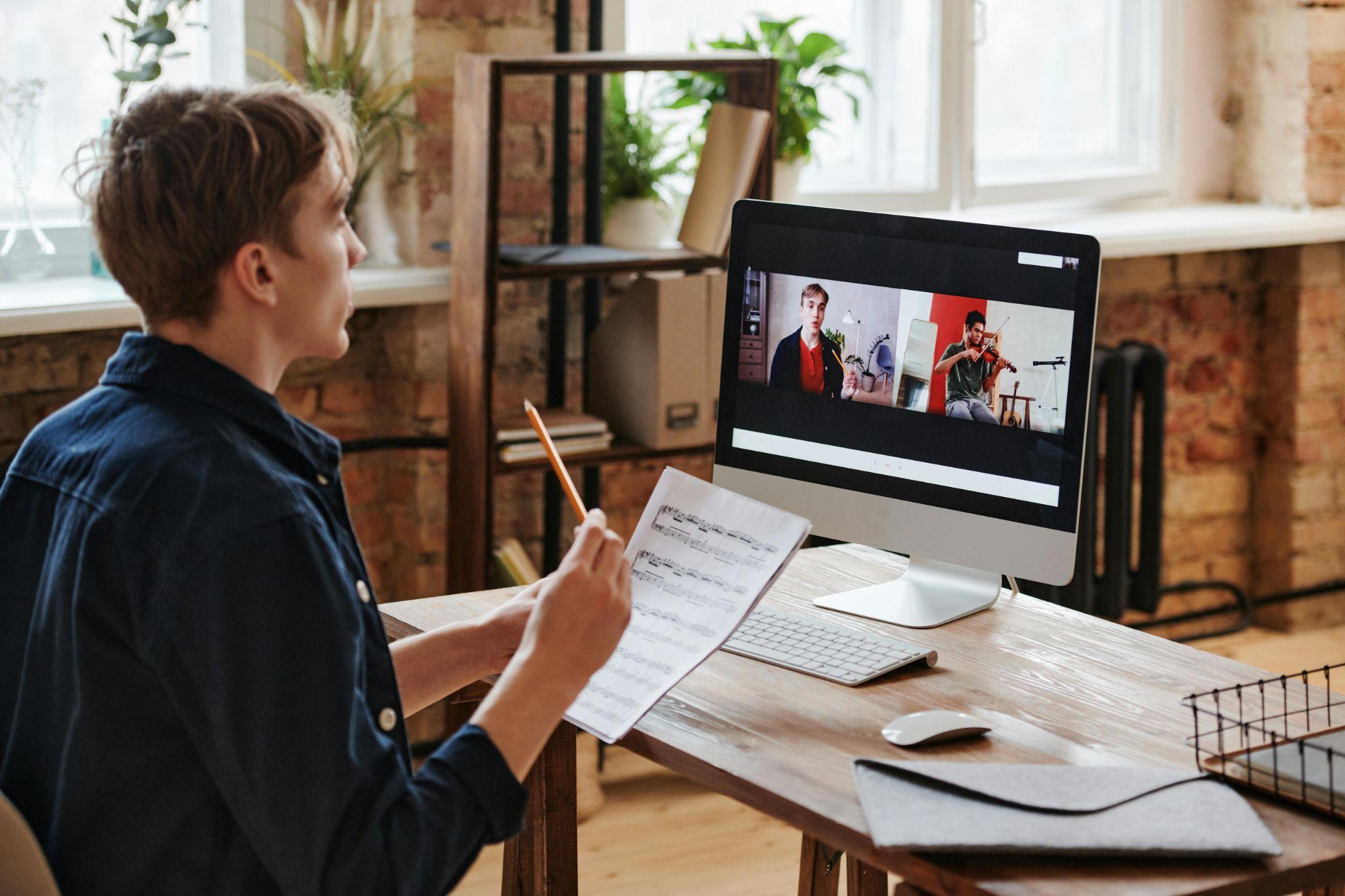
Online teaching lives or dies by communication. Without the energy of a shared physical space, clarity and warmth become even more essential.
a. Direct and Understandable Explanations
Complex musical ideas do not need complex language. The strongest virtual teachers explain advanced concepts in simple, relatable terms.
Instead of abstract theory talk, they might use imagery, physical sensations, or comparisons to everyday experiences. They check for understanding. They rephrase when needed.
Students should leave lessons knowing exactly what to practice and how to practice it.
b. A Calm and Encouraging Presence
Screens can amplify nerves. For younger students, especially, online learning can feel intimidating at first.
A great virtual violin teacher brings steadiness to the session. Corrections are clear but not harsh. Praise is specific and earned. Encouragement feels genuine, not generic.
This is where parent support can also play a helpful role for younger learners. A teacher who communicates well with parents about goals, practice routines, and expectations strengthens the student’s learning environment beyond the lesson itself.
Confidence grows when students feel seen and guided, not judged.
c. Active Listening and Adaptability
Online teaching requires attentiveness. A teacher cannot rely solely on visual cues. They must listen deeply.
Do they notice subtle rhythm inconsistencies? Do they catch intonation tendencies? Do they adapt when a student is tired or struggling?
A responsive teacher adjusts the lesson plan in real time. If a piece is causing repeated frustration, they may isolate a passage, change tempo strategy, or shift focus temporarily to a technical exercise that addresses the root issue.
This flexibility demonstrates that the teacher is not following a script but responding to the individual.
d. Clear Practice Strategy Between Lessons
Progress happens between lessons, not during them.
A strong virtual teacher outlines exactly how practice should be structured. They might recommend slow practice with a metronome, rhythmic variations, isolated shifting drills, or mental practice away from the instrument.
Students should understand how long to spend on scales, how to break down difficult measures, and how to track improvement.
Written notes, follow-up emails, or shared documents can be incredibly helpful in an online format.
e. Professionalism and Consistency
Reliability matters. Lessons should begin on time. Communication should be clear. Policies regarding scheduling and expectations should be transparent.
Professionalism builds trust. It signals that your teacher values your time and your goals.
When instruction is structured and expectations are clear, students feel secure. That security allows them to focus fully on music.
3. A Teaching Philosophy That Looks Beyond the Screen
The best virtual violin teachers think beyond weekly appointments. They are invested in long-term growth.
a. Goal Setting with Purpose
A strong teacher asks, “What are you working toward?”
It might be youth orchestra auditions, solo repertoire milestones, college preparation, or simply personal fulfillment. Clear goals shape repertoire selection and technical focus.
Online learning should not feel aimless. Even hobbyist students benefit from defined milestones.
b. Repertoire That Inspires and Challenges
Students stay engaged when they are musically excited.
A thoughtful virtual teacher chooses repertoire that aligns with technical development while still being inspiring. They may introduce pieces from different eras, styles, or composers to broaden musical understanding.
They are careful not to assign work that is too advanced too quickly. Frustration slows progress. But they also avoid keeping students in comfortable territory for too long.
Balance is everything.
c. Building Independent Musicians
A skilled virtual teacher encourages students to self-diagnose. They ask reflective questions. They guide students to solve small issues on their own before stepping in.
Over time, this builds resilience and ownership. Students learn how to practice intelligently even when the lesson ends.
d. Creating Community and Connection
Music thrives in connection.
Even in a virtual environment, teachers can create community through online recitals, studio classes, or collaborative projects. Sharing performances builds accountability and pride.
Students benefit from seeing peers at different levels. It reminds beginners that progress is possible and challenges advanced students to lead by example.
e. A Genuine Love for Teaching
Finally, look for authenticity.
A teacher who truly loves teaching will show curiosity about your progress. They will celebrate small breakthroughs. They will care about the process, not just the outcome.
Passion is visible, even through a screen. When a teacher is deeply invested, students feel it.
And that feeling sustains motivation far longer than external pressure ever could.
The Right Fit
Take your time. Ask questions. Observe how the teacher communicates during a trial lesson. The quality of your virtual violin teacher shapes how long you stay with the violin. Not how talented you are or how expensive your instrument is. A strong virtual violin teacher shows you exactly what to fix and exactly how to fix it. That kind of direction prevents months of second-guessing and stalled growth. It is the difference between playing for a season and playing for years. Choose accordingly.
Chris Heins Strings Studio delivers focused, high-level online instruction for students who want real progress, not just weekly lessons. Get in touch to begin personalized virtual violin lessons built around precision, structure, and serious musical development.